Hardware#
Figure 3: A block diagram of NGPS showing the light path and principal components of the NGPS system. A brief summary of each (and several others that are not pictured) is presented below, with more detailed descriptions following in subsequent sections.
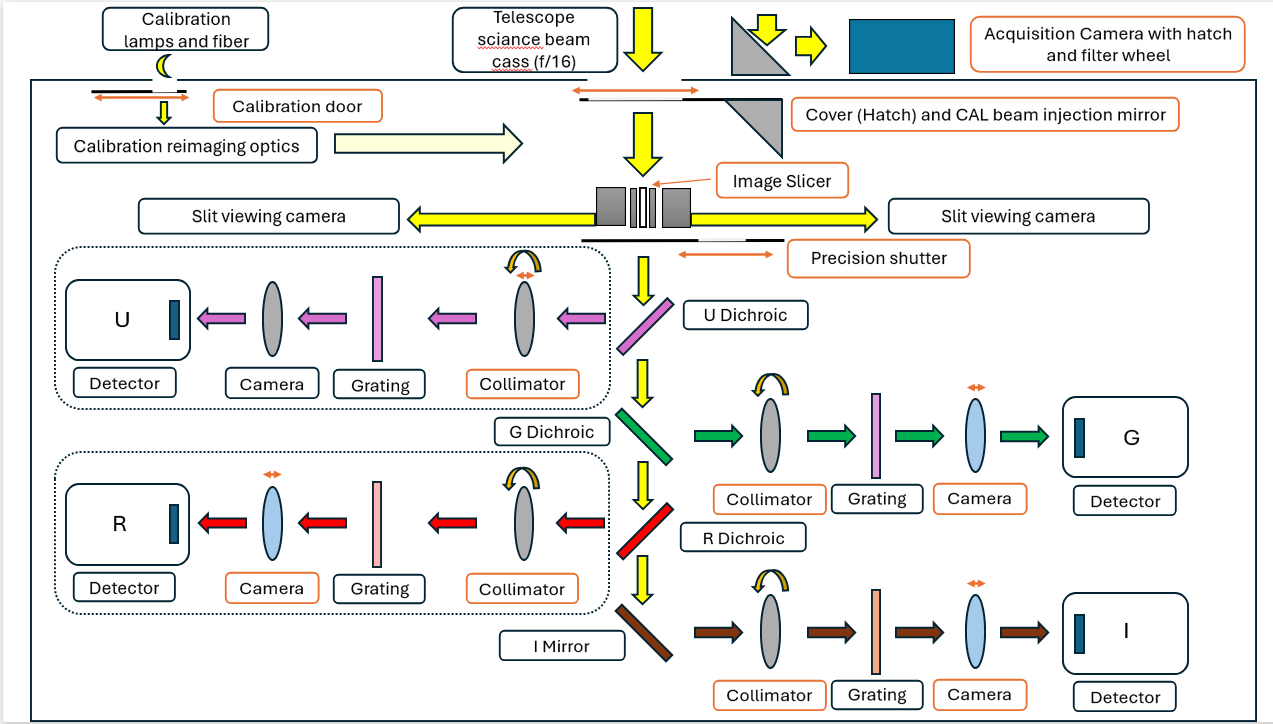
Structure — Partial exoskeleton of the NGPS optics, and instrument mechanisms. Serves as the mounting for the detector cryostats, calibration system, slicer assembly, A&G system, and electronics. Provides the mechanical interface to the P200 Cass rotator.
Instrument hatch — A small door immediately above the slicer/science FOV. Doubles as the mount for the folding mirror that redirects calibration light into the NGPS optical path.
Slicer/slit unit — Collects desired target light while blocking unwanted sky and stray light, contributes to the spectral resolution. The slicer unit relays the telescope focal plane to a reformatted slit plane. Includes mechanism for variable selection of the slit and slice width.
Shutter — The shutter mechanism controls the exposure length and light impinging upon the detectors. A single shutter is used for all detectors, imparting on the detector controller certain synchronization requirements.
Dichroic tree — Optical assembly containing three dichroic beam splitters and a mirror that performs spectral separation and folds the beam horizontally.
Collimator(s) — Forms a pupil on the grating where a mask blocks light originating outside the telescope beam; piezo actuated for flexure compensation in the dispersion direction. Also includes the focus axis for the U channel.
Diffraction grating(s) — Transmissive diffraction gratings disperse the light in the spectral direction.
Camera(s) — Refocuses the dispersed light onto the detector(s). For three channels (G, R, and I) also includes a focus mechanism.
Detector(s) — Converts optical signals for target and sky into electrical signals; includes cryostat subsystem to maintain cold, dry operation of the science CCDs.
Acquisition and Guiding (A&G) subsystem — Determines initial telescope pointing, commands telescope to move so that the desired target is correctly positioned on the slicer/slit, then continuously updates the pointing correction.
Slice viewing subsystem — Provides visual confirmation of the alignment between target and slicer/slit; user may respond by invoking a manual pointing offset.
Instrument electronics — Provide a means to control and monitor the instrument, its performance and health. Housed in a dedicated electronics cabinet attached to the underside of the structure.
Calibration unit — Provides wavelength calibration light sources. Includes a mechanism to select instrument input between telescope output and calibration unit output. Includes continuum sources for flat fielding.
Ground support equipment (GSE) — Necessary for instrument operation, including an instrument handling cart, shipping containers, and maintenance supplies.
Instrument control software — Provides both manual and automated observing modes; interfaces to the TCS; commands internal mechanisms; executes instrument automations; presents images from A&G, slice viewers, and spectroscopic detectors; provides “quick look” plots to human observers.
Data reduction pipeline — Performs bias correction, flat fielding, wavelength calibration, sky subtraction, and spectral extraction. Provides the user with object, variance, and sky spectra. Performs flux calibration if the user provides observations of a flux standard.
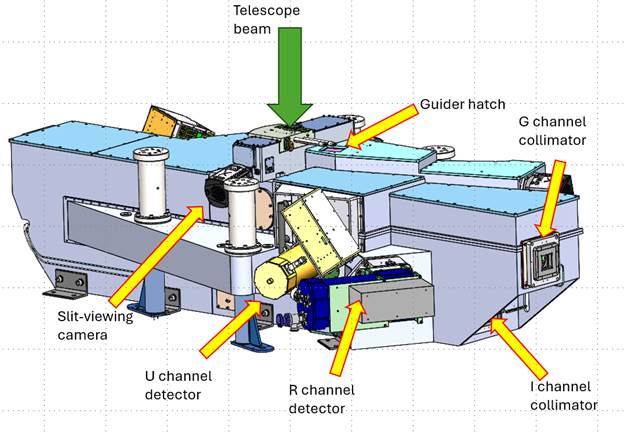
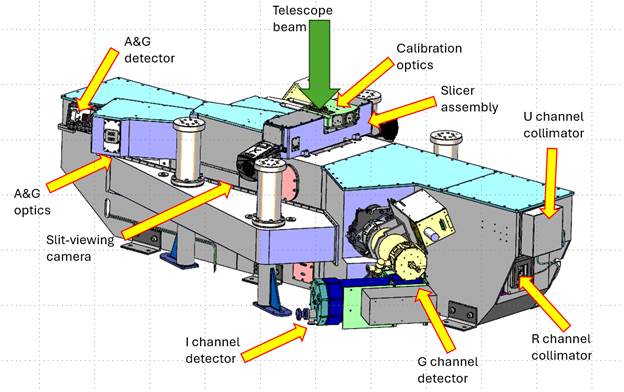
Figure 4: Main instrument body with key components visible from the outside highlighted.